
Puja Mandala
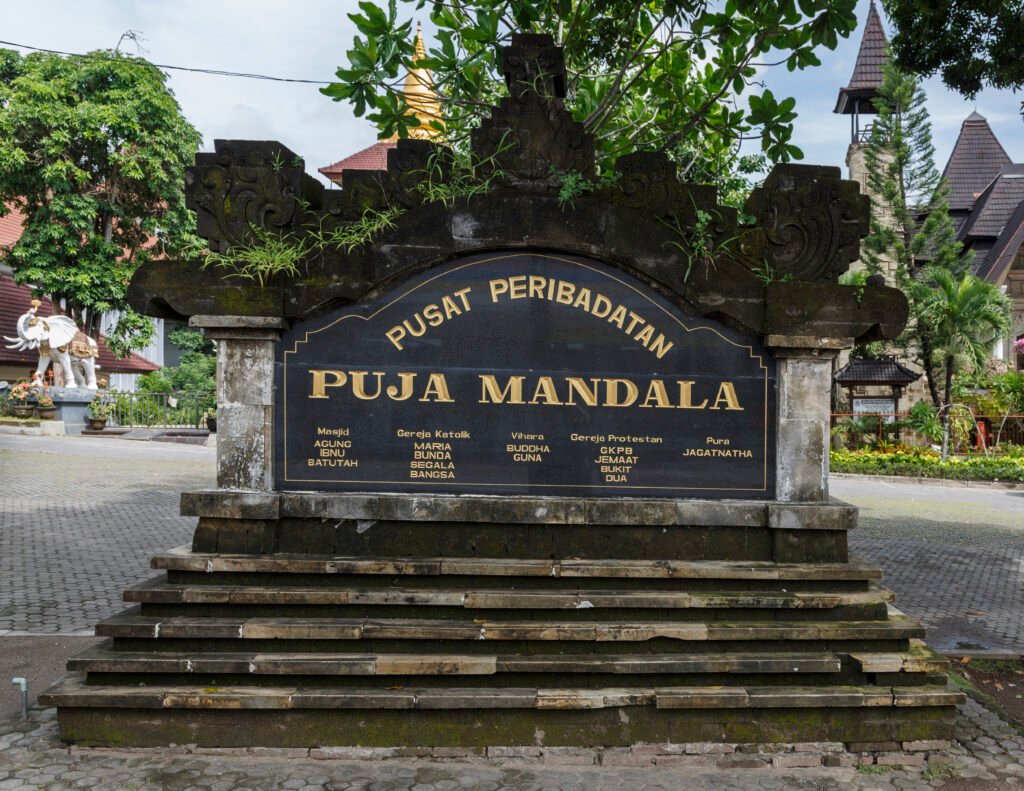
Puja Mandala is a religious complex in the Nusa Dua area where five places of worship stand alongside one another. It is often visited as a symbol of religious coexistence, but its buildings are first and foremost used by their congregations. A good visit leaves room for that everyday purpose rather than treating the complex as a museum with identical access rules throughout.
The five places of worship
The complex includes Masjid Agung Ibnu Batutah, the Catholic church Maria Bunda Segala Bangsa, the Protestant GKPB Bukit Doa church, Vihara Buddha Guna and Pura Jagat Natha. Their different architectural forms make the shared setting immediately visible.
The project began in the 1990s, with the first inauguration in 1997; the buildings were not all completed at the same time. The important visitor lesson is not a single construction date but the deliberate decision to create a shared area for different faith communities. Each congregation retains its own worship practices and identity.
How to approach the visit
Begin by observing the public exterior spaces and the relationship between the buildings. Look at entrances, roof forms and the way each place expresses its religious tradition. If you want to enter a particular building, ask the relevant caretaker or staff member rather than assuming one permission covers the whole complex.
A service, prayer time, wedding or other event may change access. Give worshippers priority and avoid walking through a gathering to complete a sightseeing route. A brief, quiet exterior visit can still be meaningful when interiors are unavailable.
Dress and photography
Choose modest clothing that covers shoulders and knees, and carry an additional layer if needed. Requirements differ by building, including footwear removal or head covering in some contexts. Follow the instructions at each entrance rather than applying one rule to every faith.
Ask before photographing an interior or people at worship. Keep your phone silent, avoid flash unless explicitly permitted and do not pose on sacred furniture or structures. Children can enjoy comparing architecture, but explain that the space calls for quieter behaviour than a beach or playground.
Timing and practical details
Use Puja Mandala in the Nusa Dua / Kampial area as the destination for transport. It is inland from the beach, so do not assume a beachfront drop-off is within an easy walk. Save the entrance location and arrange a clear pickup point if you are continuing elsewhere.
There is no single visitor schedule that should be assumed to apply to all five buildings. Contact the relevant place of worship if interior access is central to your plan. This guide does not quote an unverified universal entry fee or promise that every building will be open during a sightseeing visit.
Making the visit more thoughtful
Allow time to observe without rushing from one doorway to the next. If someone is available to answer questions, ask respectfully about the building’s community and practice rather than expecting a formal tour. Avoid comparing religions as a competition over which structure is the most photogenic.
The complex is also useful for families or groups discussing diversity in Indonesia. Focus on the practical reality of sharing space while maintaining distinct traditions. That is more informative than treating the site only as a backdrop for a group photograph.
Nearby destinations
Museum Pasifika complements the visit with a different perspective on cultural exchange. Mengiat Beach and Geger Beach can provide relaxed outdoor time after changing into suitable beach clothing. Water Blow Nusa Dua is another option, subject to sea conditions and visitor access.
Can tourists enter all five buildings?
Permission and availability vary. Ask at each building and respect worship schedules and restricted spaces.
Is Puja Mandala a single temple?
No. It is a shared complex containing five distinct places of worship from different faith communities.
Sources: Indonesia Travel: Puja Mandala history and places of worship.
Photo: CEphoto, Uwe Aranas / Wikimedia Commons, CC BY-SA 3.0. No editorial changes by BaliFinder; WordPress may generate display sizes. Source photograph dated 2015-02-12.
